Virtual Environments for Surgical Simulation
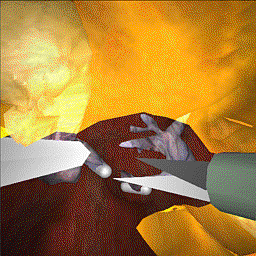 VESTA laparoscopic cholecsytectomy simulator.
Goals
Learning laparoscopic techniques is much more difficult for surgeons than learning open surgery procedures. Currently, surgeons are trained during actual operations or in the animal laboratory. Training in the operating room increases risk to the patient and slows the operation, resulting in greater cost. Animal training is expensive and cannot duplicate human anatomy. Computer-based training has many potential advantages. It is interactive, yet an instructor’s presence is not necessary, so students may practice in their free moments. Any pathology or anatomical variation can be created. Simulated positions and forces can be recorded to compare with established performance metrics for assessment and credentialing. Students could also try different techniques and look at anatomy from perspectives that would be impossible during surgery.
In the context of this application, I have worked on the development of real-time finite element models of soft tissue behavior and high fidelity haptic interfacing to deformable object models simulated in virtual environments, to generate a realistic environment for training.
